

If you want to run a faster 5K, mileage alone won’t cut it. Speed comes from force production—how much power you can put into the ground with each stride, and how efficiently you can repeat it for 3.1 miles. Smart strength training builds that engine without adding unnecessary bulk.
The goal isn’t to lift like a bodybuilder. It’s to develop strong hips, elastic tendons, and fatigue-resistant mechanics that translate directly to faster splits.
Here are of the three most effective lifting exercises for improving 5K speed—and why they work.
1. Bulgarian Split Squat
The single-leg strength king for runners

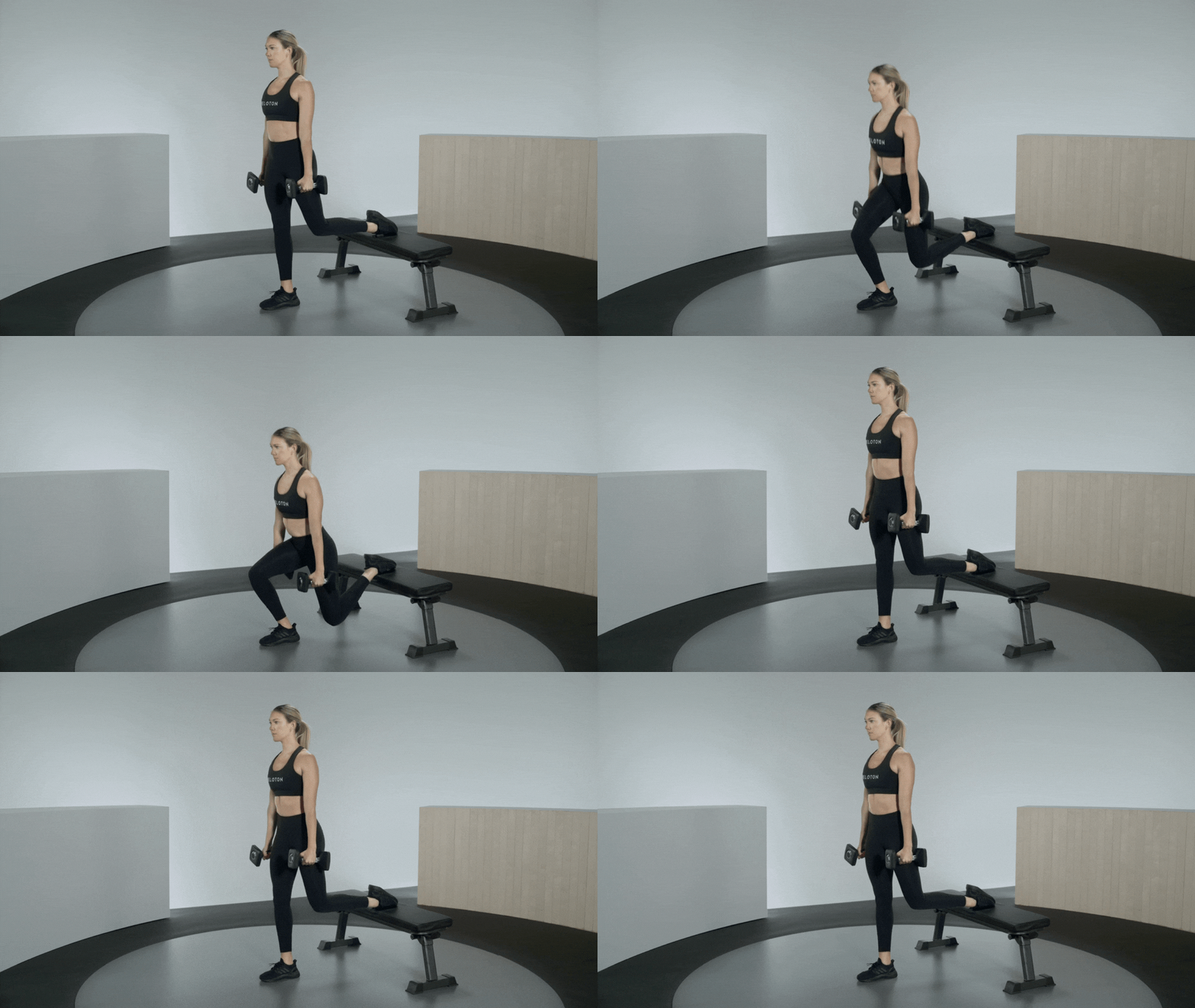

Running is a single-leg sport. Every stride is essentially a one-legged squat with a flight phase, and the Bulgarian split squat trains that exact demand.
This exercise builds:
-
Glute and quad strength for propulsion
-
Hip stability to reduce energy leaks
-
Left-right balance, which improves stride symmetry
Unlike bilateral squats, Bulgarian split squats load each leg independently, forcing the stabilizers to work overtime—just like during running.
How it improves 5K speed:
Stronger single-leg force means a more powerful push-off and less collapse late in the race when fatigue sets in.
How to program it
-
3–4 sets of 5–8 reps per leg
-
Moderate to heavy load
-
Controlled tempo, full depth
2. Romanian Deadlift (RDL)
Posterior-chain power for longer, faster strides


If you want speed that lasts beyond the first mile, you need a bulletproof posterior chain. The Romanian deadlift targets the hamstrings, glutes, and spinal stabilizers, which are critical for maintaining stride length and posture at race pace.
Runners often over-rely on quads. RDLs rebalance that equation.
This exercise builds:
-
Hamstring strength for late-race turnover
-
Hip hinge efficiency
-
Injury resilience, especially against pulls and strains
How it improves 5K speed:
Stronger hamstrings help you cycle the leg faster and maintain stride length as fatigue accumulates—key for holding pace in the final kilometer.
How to program it
-
3–4 sets of 6–10 reps
-
Emphasize slow eccentrics
-
Keep the bar close, spine neutral
3. Weighted Step-Ups
Specific strength that transfers directly to running


Step-ups may look simple, but they’re brutally effective when loaded correctly. They mimic the exact action of driving your body upward and forward over a single stance leg—just like running.
This exercise builds:
-
Hip drive and knee extension
-
Coordination under load
-
Strength endurance at race-relevant joint angles
The key is step height. Too low and it becomes junk volume. Aim for a box roughly knee-height or slightly below.
How it improves 5K speed:
Better force application at mid-stance means improved running economy—less effort for the same pace.
How to program it
-
3 sets of 8–12 reps per leg
-
Moderate load, smooth drive
-
No bouncing off the back leg
How to Use These Lifts Without Killing Your Running
To gain speed—not soreness—keep lifting 2 days per week, ideally after easy runs or on quality workout days. Avoid heavy lifting the day before intervals or races.
A simple setup:
-
Day 1: Bulgarian split squat + RDL
-
Day 2: Step-ups + light posterior-chain work
Keep reps clean, rest generous, and focus on intent—strong, fast, and controlled.
Bottom Line
The fastest 5K runners aren’t just aerobically fit—they’re strong where it matters.
Build single-leg strength, reinforce the posterior chain, and train force production that actually carries over to running.
Lift smart, run fast, and let strength make every stride count.